
I recently completed a project that was about as far from my corporate learning ‘safe zone’ as it is possible to get.
It was great to learn something completely different, and apply my skills to a new area. Here’s what happened
The learning covered a highly sensitive topic that many people would prefer to avoid – how can you assure adults in care environments of their right to personal sexual expression and intimate relationships, while also keeping them safe?
The project arose out of discussions between a local authority safeguarding partnership and the Social Care Institute for Excellence (SCIE). The safeguarding partnership is a group of care organisations and services that aims to provide a ‘joined-up’ approach to safeguarding issues in their area.
The problem to be solved
Safeguarding in adult social care is a sensitive topic that requires care professionals to act with sensitivity and understanding. There are also a legal aspect to this work – you need to be aware of a person’s rights and how they may affect your responsibilities as a carer.
SCIE and the safeguarding team were looking for a cost-effective way to give frontline care professionals the information and guidance they need to advocate for the people they care for. SCIE already offers excellent classroom-based learning, but the audience reach for this approach is limited. Also, it relies on learners passing on their new knowledge to their colleagues, which carries a number of risks. Add to that the time constraints on an already hard-pressed workforce, not many care professionals can find the time for a half-day workshop.
On top of that, there is a lot of information out there – dozens of resources, papers, guidelines and advice on this topic – but it comes from many places, and it’s quite time-consuming to find. The solution, therefore, had to be:
- Easily accessible at any time
- Provide comprehensive information on rights and responsibilities
- Give learners the confidence to consult with the people they care for and help them to meet their personal need for intimacy
The safeguarding team had some digital learning on their website and reported that it was popular with partners and care professionals. After some discussion we decided to create a digital learning module that curated key guidelines, advice and information from leading organisations, and presented it in an accessible, digestible format.
The technology
The client has Lifter LMS – a WordPress plug-in learning platform. After some muttering about not being able to use Rise, I discovered the Lifter platform offered a range of simple interactions, quizzes and you can host videos too. Most importantly, you can make the content look nice and control the learner journey.


The approach
We agreed that attending a SCIE training session would help me get a handle on the issues discussed, and find out more about the target audience of care professionals. My big takeaway regarding care professionals is that they are an incredible bunch of people and it was a privilege to spend time with them.
I didn’t want to launch straight into production, so I set my ideas out in a storyboard that gave the stakeholders a chance to review the content and learning approach, and check that I’m going in the eight direction.
When writing the learning I adopted a ‘Learn/Reflection/Action’ approach to the learning as it has worked well for other digital modules I’ve worked on in the past.
The Learn section provides information in digestible chunks for the learner.
Reflection gives them opportunities to pause and reflect on how these issues may affect their practice.
The Action section offers frameworks, guidelines and ideas for implementing their new knowledge.
I pulled information from a variety of sources, all checked over by the stakeholder. Previous experience of working on another SCIE project gave me a good idea of which SCIE resources to use, and the clients very helpfully provided me with more ideas. The learning focused on three questions:
- What are intimate relationships and why are they important?
- What you (as a care professional need to know)
- Practical steps that you can take
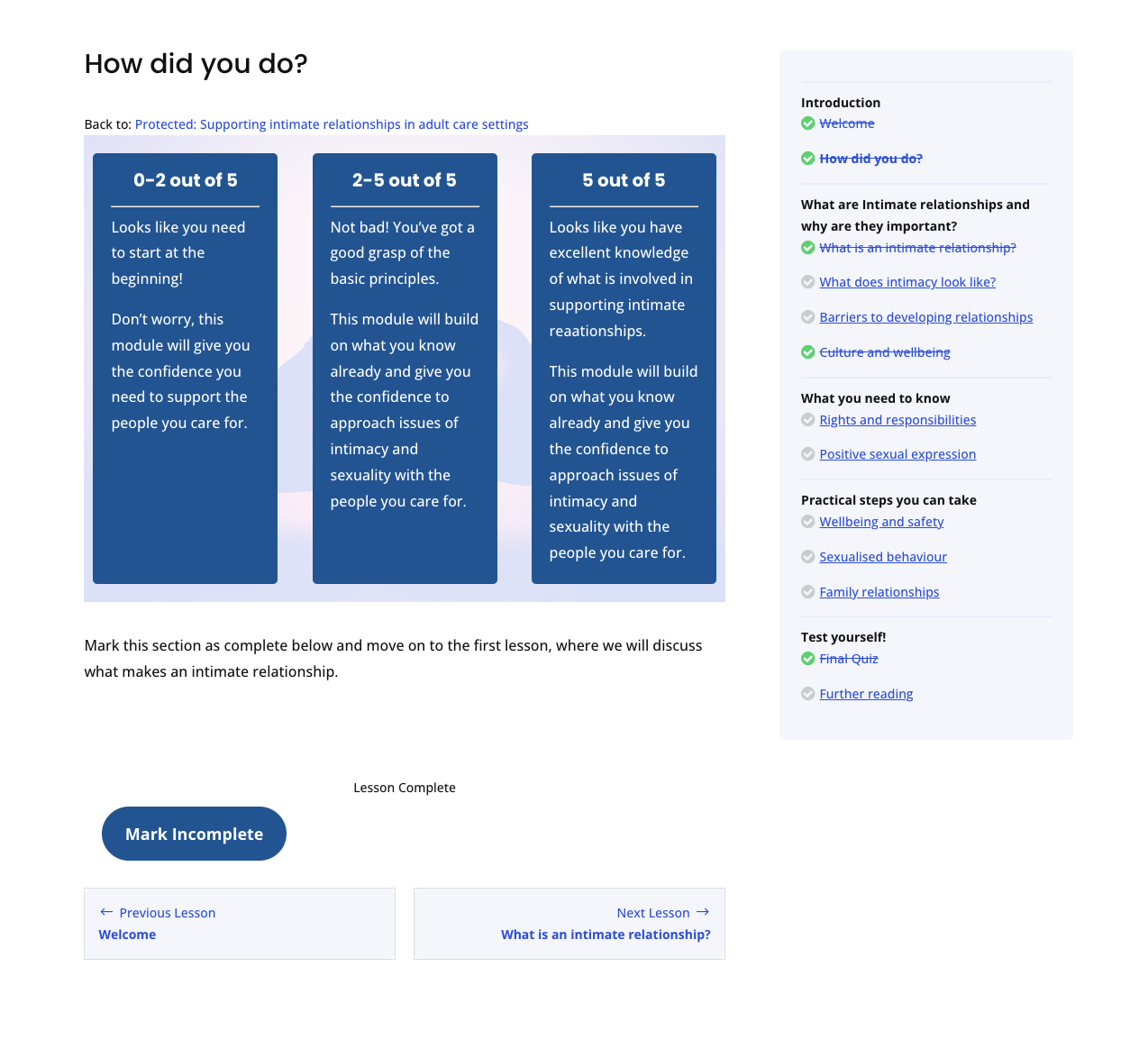
It started with a quiz…
The initial quiz poses questions that the learners will find answers for as they progress through the course. It also helps establish their base knowledge.
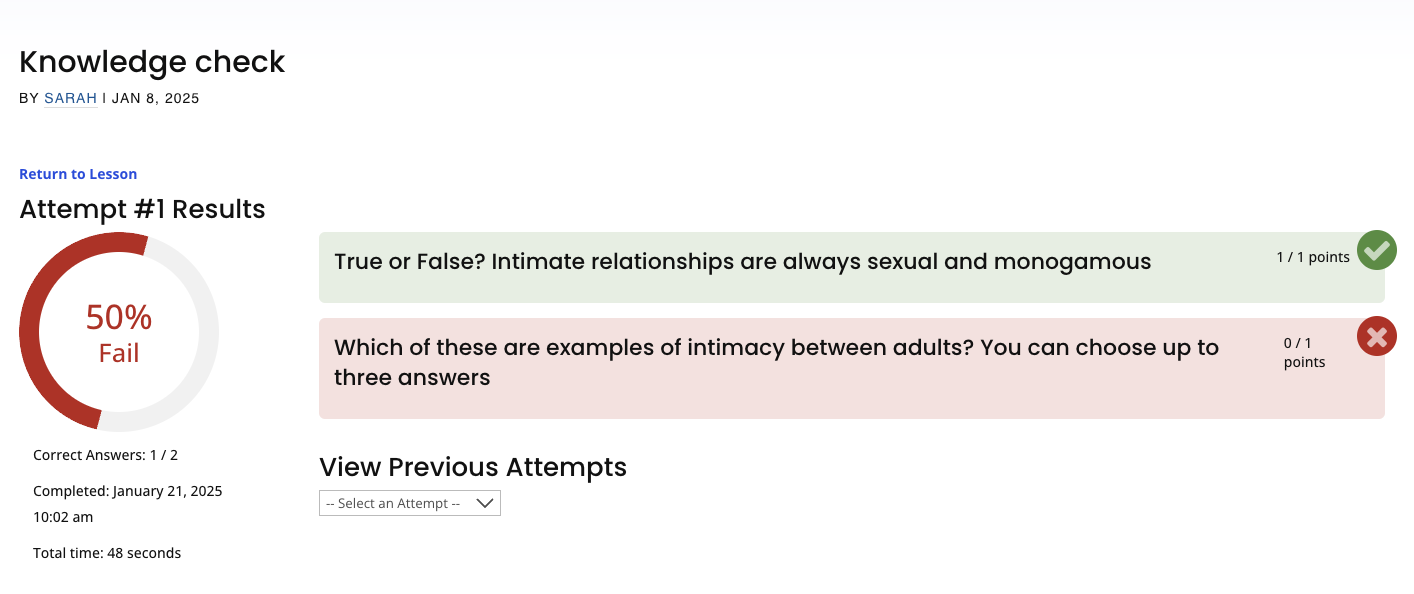
Each section had a quick two-question knowledge check based on the content. Learners could not progress until they achieved the passing score.
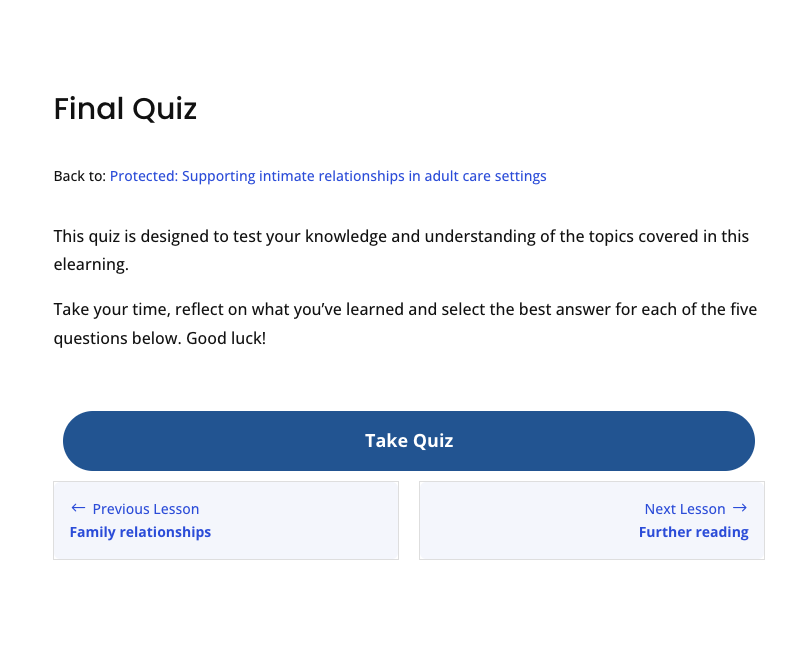
At the end of the module, learners take a five question quiz to test their knowledge. Learners can’t mark the learning as complete until they achieve a passing score.
Project phases
There were two main feedback phases for this project. The first version was conducted by the principal stakeholder, who suggested a few extra sources to include. The second, longer review went out to 30 local stakeholders, including the SCIE safeguarding team, who provided feedback and comments.
Once the beta corrections were in place, the principal stakeholder did a final review, and we formally signed off on the project.
Next steps
The client is now planning to release the learning as a free resource for all care professionals, wherever they are. Following on from that, we hope to start working on a blended programme that enhances learners’ core knowledge and builds their confidence.
 Sarah Slade
You must be logged in to post a comment.