My last contract required me to dip into two areas of experience and combine my learning experience design skills with researching and writing informative content. Here are a few of my thoughts.
The work involved creating digital learning assets that extremely busy people (frontline social care workers) could access in their breaks to help support them to make good decisions. Social care professionals aim to promote and enable a more personalised model of care that empowers an individual to make their own decisions, and for care teams to work in partnership with their clients. There are legal frameworks and legislation to support this way of working, but, as I discovered during the discovery phase, there’s a lot to remember in a very short time. .
On a personal note, it was quite strange (and a bit of a luxury) for me to take a step back from being Mrs Project Lead and only run a part of the process. It enabled me to focus on research and writing some lovely content that fitted the brief perfectly.
So how did I apply 5Di to all this? I know 5Di is essentially a learning design framework, but the first three sections (Define/Design/Develop) worked really well as a way of guiding my practice in this project (with a bit of help from Ros Atkins).
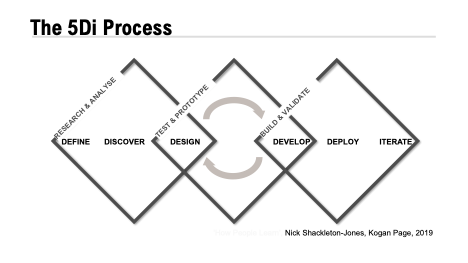
Define/Discovery
I only had a short time on this project, and I wasn’t running the show, so the Define/Discovery phase (normally my favourite bit) was short. We agreed the scope of my work in our pre-meetings, and that was to focus on generating the right content for the app. The team had already run several workshops and stakeholder interviews, so I was able to extract what I needed from that information. I also worked with the team and a select band of users on the prototype design reviews, and got some interesting insights that I fed back into the content design process.
Develop
Researching the content and approach was constrained by the technology available for the prototype. The principal themes were that the content had to supply just-in-time learning support for frontline staff in an easy-to-read, accessible format on a mobile phone. Because we were limited to simple text and images rather than anything fully multimedia, we decided to create a set of guides and tips that guided users through key topics such as dementia care, behaviour management, nutrition and privacy.
The sting in the tail was that each article had to be no more than 200 words in length, which is where Ros Atkins’ ideas were helpful.
I went back to The Art of Explanation and used the learning to create a list of questions to keep in mind:
- What is this thing that I need to tell my audience? Why is does it mater?
- What does my audience need to know?
- How can my audience help their clients?
- What do they need to do if things don’t work out the way they should?
- What is the simplest way I can say all of this?
Many of the issues I wrote about were complex and almost impossible to confine to 200 words. To get around that we created a narrative flow of questions that worked well as a full article, but could also work as standalone mini modules. For example an article on inappropriate behaviour might start with a definition, then give some examples, then have some advice on what to do. We worked hard on the headings to make sure that each section of the article would work both as a standalone mini module and as part of the full article. The most efficient approach was to frame each module as an answer to a question, for example:
- What is inappropriate behaviour?
- What does inappropriate behaviour look like?
- What can I do when my client behaves inappropriately towards me?
Working this way enabled me to keep my research focused on finding the information that would answer these questions and stopped me from flying off on any number of tangents.
Even so, I now probably know more than is strictly necessary about the treatment of haemorrhoids.
 Sarah Slade
You must be logged in to post a comment.